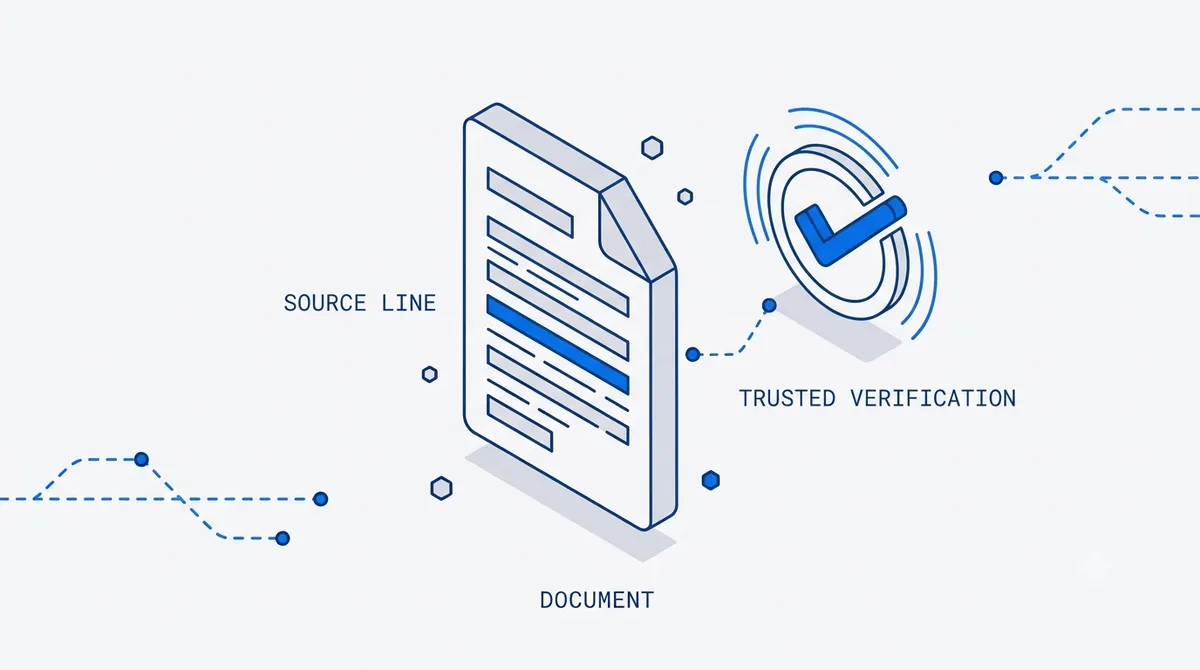
The difference between a chatbot and a tool you can rely on is the citation. If the model cannot point to the page a claim came from, the claim does not ship. That is not a stylistic preference; it is the line between an AI answer you can act on and a guess dressed up in confident prose.
The hallucination problem, plainly
Large language models are fluent by design. They produce text that sounds right whether or not it is right. Ask an ungrounded model about a contract clause and it will happily invent one, complete with a plausible section number. The wording is convincing; the clause does not exist. This is hallucination, and it is not a bug you can prompt your way out of. It is what happens when a model answers from its own memory instead of from your document.
The fix is not a smarter model. It is a different architecture: the answer must be built from the actual text of your file, and it must show you where each claim lives.
What page-level citations change
A page-level citation attaches every claim in an answer to the exact page, and often the exact passage, it came from. That single feature changes the relationship between you and the tool.
- You can verify in one click. When an answer says the renewal term is 24 months, you click the citation and read the sentence yourself. Trust becomes checkable rather than assumed.
- Hallucinations get caught. If a claim has no source to link to, that is a signal. Grounded answers are only as broad as the passages behind them.
- A document summary with citations becomes usable. A summary you cannot trace is a nice paragraph. A summary where every point links back to its page is something you can quote, forward, or build a decision on.
How we keep citations honest
Getting citations right is more than printing a page number. Behind every answer:
- Answers are grounded only in retrieved passages. The model works from text pulled out of your document, not from its training data. It answers what your file says, not what it assumes documents like yours usually say.
- Each claim links to its page and snippet. A citation context extractor identifies the specific passage supporting a statement and surfaces it alongside the answer, so the evidence travels with the conclusion.
- Faithfulness is measured, not assumed. We test whether answers actually reflect their cited sources, rather than trusting that grounding happened. An answer that drifts from its citation is a failure we can detect and fix.
Why this matters more than model size
It is tempting to think the answer to hallucination is a bigger, newer model. But a more capable model that answers from memory is a more convincing way to be wrong. The reliable path is verifiable grounding: retrieve the relevant passages, answer from them, and show the source. That approach works across contracts, research papers, financial reports, and manuals alike, because it does not depend on the model happening to know your document. It depends on the document being in front of it.
This is also why citations and privacy fit together. Your PDF stays in your browser and is never uploaded to a server; only the text needed to answer a question is sent to the AI over an encrypted connection, and it is never used for training. The answer is built from your file, cited to your file, and your file stays yours. If privacy is your main concern, see our deeper note on private PDF AI.
Common questions
Do citations guarantee the answer is correct? They guarantee it is checkable. The citation points you to the source so you can confirm the claim yourself. Verifiability, not blind trust, is the goal.
What happens when there is no source for a claim? A grounded answer stays within its retrieved passages. If there is nothing to cite, that absence is itself informative, and it is why traceable answers surface hallucinations instead of hiding them.
Can I get citations on a summary too? Yes. A document summary with citations links each point back to its page, so you can trace a summary the same way you trace a direct answer.
See how traceable answers feel in practice. Try it on your own document with chat with PDF.
Written by
Dana Reyes
Content, PDFLove AI
Dana covers how teams in legal, finance, and research put AI document tools to work — with an eye on citations, accuracy, and staying compliant.